

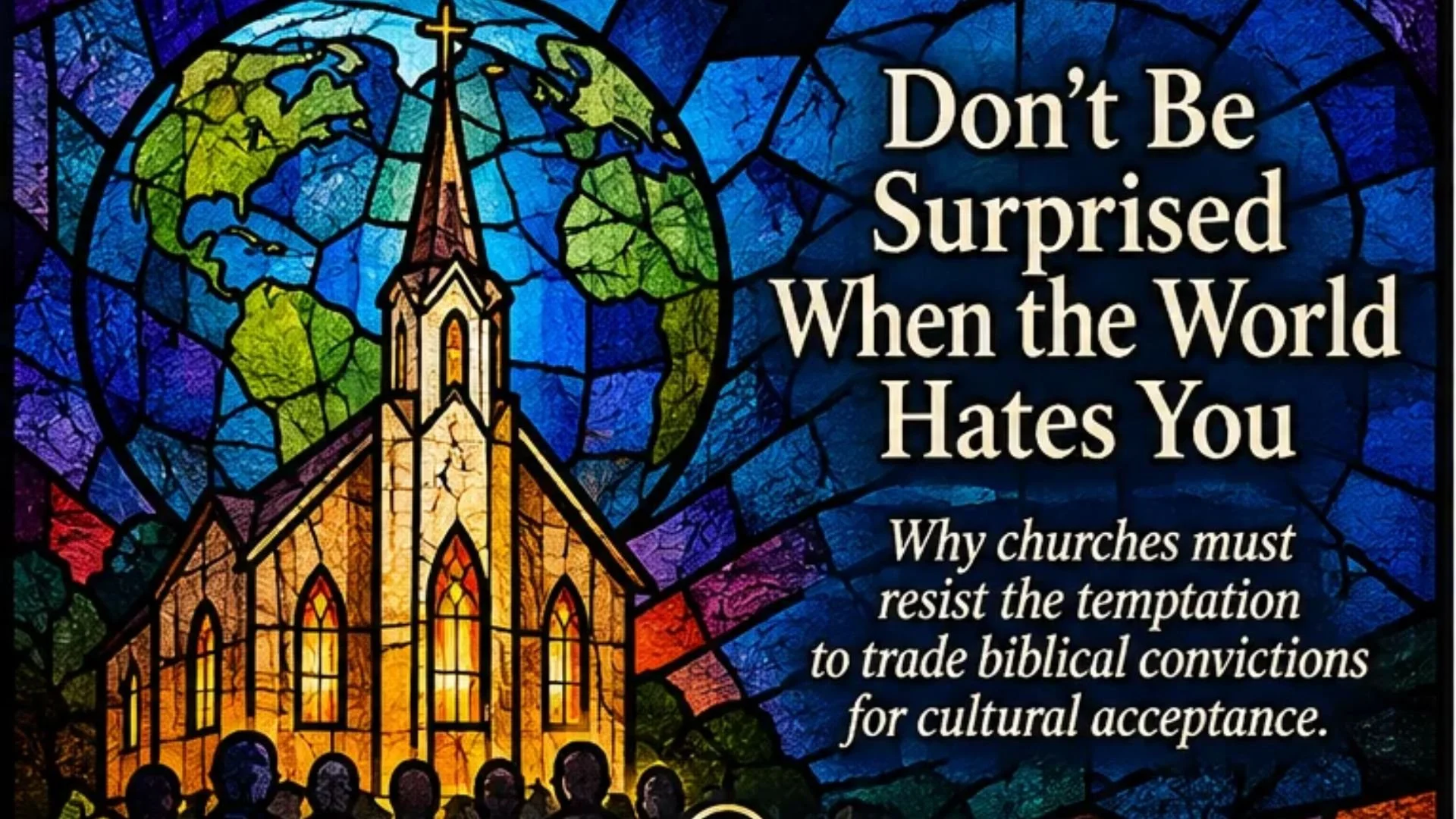
A Field Guide to Christian Living in a World Hostile to Christianity (Part 1)
Thanksgiving is right around the corner.
As we’re busy preparing for the big day, I felt it necessary to prepare Christ-followers for the conversations that may take place around the table.
You see, there is a growing tension between historic, biblical Christianity and the values many in modern society cherish. The gap between what Christ teaches and what the culture celebrates is steadily widening. And if we’re honest, many churches aren’t quite sure what to do about it.
We want to reach people, build relationships in our neighborhood, and for our churches to be welcoming and hospitable spaces where people encounter the grace and love of Jesus.
Those are good desires for us to have. No doubt.
But what happens when the very things Jesus taught become the things our culture rejects? What happens when biblical convictions are labeled intolerant, hateful, or dangerous?
“The gap between what Christ teaches and what the culture celebrates is steadily widening.”
Perhaps you’re thinking, “Mike, you’re being a bit dramatic.”
Maybe. I’m open to being wrong.
But I don’t think what I’m sharing is far from reality for most of us.
And yes, I have data to back that up.
drift from the moral center
A 2025 Pew Research study found that 58% of American adults believe there is at least some conflict between their religious beliefs and mainstream American culture. Among white evangelical protestants that number rises to 80%. Among black protestants, that number sits at 58%. Among white non-evangelical protestants, that number is 52% (Pew Research, 2025).
Here’s what this means. Among American Christians, whatever their theological emphasis or denominational “flavor” may be, more than half of those surveyed see their beliefs about God, the scriptures, the life and ministry of Jesus, etc. to be at odds with mainstream cultural ideology.
Questions of how we engage with a culture that holds a negative view toward Christians are no longer hypothetical. Therefore, we no longer have the luxury to not ask them.
We are in the throes of a massive cultural shift, the likes of which no one in our lifetime has ever seen. That is not meant to cause alarm, but to make us aware. My hope is that we can better understand what this means, and how we can live faithful, gospel-centered lives in the midst of it.
Many have debated over whether America is truly a “Christian nation” but something most believers should agree on is America was always at its best when the populous freely embraced Judeo-Christian values, even if they didn’t fully embrace Christ.
You likely recall a time sitting with loved ones around the Thanksgiving table where you knew there was a general consensus around properly basic moral and ethical beliefs—be it the the sanctity of marriage, the intrinsic value of life in the womb, or just the simple fact that men are men and women are women.
But now we can hardly agree on what we consider moral or ethical anymore. You can’t even pose the question “What is a woman?” without risking a debate around personal autonomy and gender expression.
Whether you’re reading this as a pastor, a church leader, or a church attender, there is something we must grapple with: The luxuries Christians have enjoyed in the West are slowly fading away. And as the culture moves further away from its moral and ethical center, we can expect hostility to be directed at those who remain securely anchored in them and the gospel where they find their origin.
What we so quickly forget is the freedom to worship and express our Christian conviction sans consequence is relatively thin in the history books.
Let me put it this way:
Loving and following Jesus with everything we have and NOT getting persecuted for it is an exception, not the rule.
But you don’t have to take my word for it.
what jesus said
In John 15, Jesus prepares His disciples for something they probably weren’t anticipating.
Earlier in the chapter (the famous “abide” section at the top) Jesus spent a considerable amount of time explaining what His kingdom will look like. As His followers, they are to remain connected to Him, love one another, obey His commands, experience His joy, and bear spiritual fruit.
In a perfect world, a community characterized by self-sacrifice, generosity, grace, enemy love, and radical forgiveness would be welcomed by everyone.
But Jesus makes it clear that it wouldn’t. Jesus says it very plainly:
“If the world hates you, know that it has hated me before it hated you.” - John 15:18 (ESV)
“World” here isn’t referring to the planet or to humanity, but to the world system. You might call it the “present age.” These are the attitudes, values, priorities, and patterns of life that belong to a society that lives in opposition to God.
In other words, Jesus is describing a fundamental conflict between two competing kingdoms.
And the church belongs to one of them.
“the World refers to the attitudes, values, priorities, and patterns of life that belong to a society that lives in opposition to God.”
the temptation to become more acceptable
Here’s where things may get uncomfortable for church leaders. Especially if you’re a textbook people-pleaser, like me.
When the surrounding culture becomes increasingly hostile to biblical Christianity, churches face the temptation of making the idea of following Jesus more palatable.
We might not openly deny our theological convictions. Instead we just de-emphasize certain teachings that may “ruffle people’s feathers.”
We might avoid difficult passages in scripture. Taken to another extreme, a church may even redefine value based nomenclature. It is very easy to embrace vague notions of or redefine terms like “love”, “grace”, or “justice” so they neatly fit within contemporary cultural expectations.
There’s a subtle deception in it too. We can tell ourselves a noble story. We say things like:
“We’re being strategic”
“We want to reach people”
“We don’t want unnecessary barriers”
But there is a difference between removing unnecessary barriers to the gospel and neutering the gospel of its very ethos.
A church can become so concerned about cultural acceptance that it loses its willingness to challenge the culture.
And when that happens, the church is no longer helping people become more fully-devoted to Jesus. It instead becomes a sort of scaffolding for ideas that make people feel comfortable with a version of Christianity that was never promoted or taught by Jesus and the Apostles.
Pastors, elders, and ministry leaders, we need to be asking some difficult questions:
Are we teaching the whole counsel of God, or just the portions that are culturally acceptable?
Are we discipling people to follow Jesus even when obedience costs something?
Are we preparing our congregations for opposition, or have we taught them to expect cultural approval?
Are we more concerned about causing offense than we are about being faithful to Christ?
To be clear, these are not questions about whether we should be loving, welcoming and gracious. Of course we should. But they are questions about whether we’ve made obedience to Christ subservient to cultural accommodation.
don’t confuse opposition with failure
One of the most important things Jesus communicates in John 15 is that opposition doesn't necessarily mean something has gone wrong.
It’s true that sometimes churches will experience outside criticism because they have been unfaithful to the gospel. We read about those stories in spades today. More pastors today are being removed from their position of authority because they've displayed consistent patterns of being abrasive, arrogant and abusive.
That is the right thing to do, and church leadership needs to own that when it happens.
But sometimes cultural opposition comes precisely because a church is faithfully following Jesus.
We shouldn't assume that every negative response aimed at the church is evidence that we need to change our message.
John Mark Comer, in Live No Lies, describes a cultural shift from widespread tolerance toward increasing hostility, noting that some people now view traditional Christian convictions not merely as strange but as a threat to their vision of human flourishing (Comer, Live No Lies, xxv).
That's worth considering.
The church doesn't exist to affirm every cultural assumption. It exists to proclaim Christ, make disciples, and demonstrate what life under His lordship looks like.
And that will put us at odds with the surrounding culture. It may even put us at odds with someone we love.
But sometimes we have to love someone more than we love our relationship to them.
What churches need to recover
If we're going to remain faithful in a hostile environment, it starts with recovering a biblical understanding of our identity.
We are not a political movement. We are not a cultural preservation society. We are not a social club trying to maintain relevance. We are the people of Jesus.
“sometimes we have to love someone more than we love our relationship to them.”
Our identity is rooted in Him. Our authority comes from His Word. Our mission is established by Him. And our ultimate allegiance belongs to Him.
That means we cannot allow the shifting approval of the culture to determine what we believe, what we teach, or how we live.
The question isn't whether our friends, neighbors and family will always like what we believe. The question is whether they can look at our churches and see people who genuinely belong to Jesus.
For church leaders reading, let’s embrace the hard reality that we need to stop preparing our congregations to be liked by the world and start preparing them to be faithful to Christ.
Because Jesus never promised that the world would applaud His followers. He promised that He would never leave them.
Grace & Peace,
Mike
Sources & Further reading:
John 15:18–27; John 17:14–18; Romans 12:1–2; 1 John 2:15–17.
Pew Research Center, Religion Is Gaining Influence in American Life, More U.S. Adults Now Say (October 20, 2025).
John Mark Comer, Live No Lies: Recognize and Resist the Three Enemies That Sabotage Your Peace (WaterBrook, 2021).
