

Why Pastors Must Lead the Church Out of Hurry
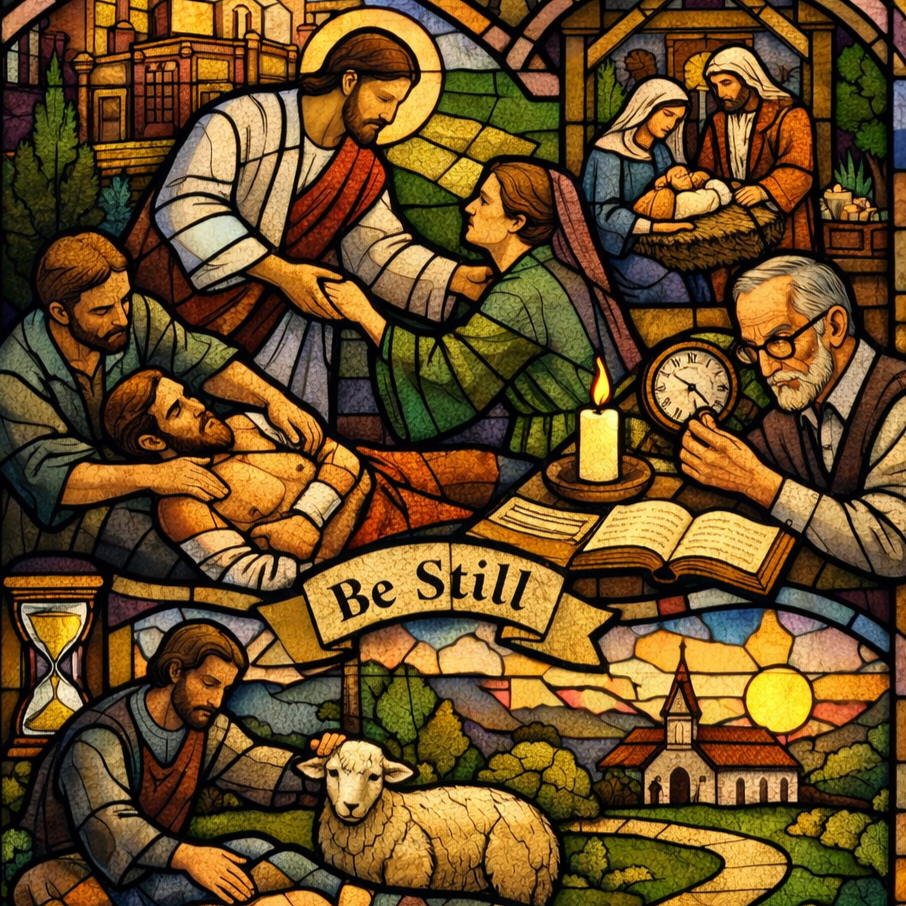
December is one of the most ironic months in the life of the Church.
We sing about peace on earth while sprinting toward exhaustion.¹ We proclaim Emmanuel—God with us—while rarely being fully present with anyone.
For pastors and church leaders, December doesn’t just feel busy—it often feels unavoidable. Extra services. Extra meetings. Extra expectations. Extra pastoral care needs. And because ministry is always framed in the language of urgency, we rarely question the pace at which we’re operating.
We may never say it out loud, but we live as though rest is a luxury rather than a necessity for spiritual health.
Hurry Is Not a Neutral Leadership Issue
Research increasingly confirms what Scripture has been teaching for millennia: chronic busyness is not just unhealthy—it’s formational.²
In one commonly cited social experiment, 8 out of 10 people answered “busy” when asked how they were doing. Busy has become our default emotional state.
Over half of Americans report multitasking regularly, often doing two or three things at once.
Studies of the global workforce show that employees spend nearly 60% of their workday on “work about work”—emails, meetings, task-switching—rather than the job they were hired for.³
One-third of U.S. adults sleep less than the recommended 7 hours, and more than 75% report feeling burned out, citing constant availability and lack of rest.⁴
Pastors are not exempt from these patterns. In fact, ministry often sanctifies hurry by baptizing it in spiritual language: People need me. Souls are at stake. This season is intense.
Dallas Willard famously warned, “Hurry is the great enemy of the spiritual life.”⁵
Not sin. Not unbelief. Hurry.
Obviously, sin and doubt can and do derail the life and witness of a Christian leader, but the devil can subtly, quietly use hurry to crowd out the very things that form us into Christlike leaders: prayer, attentiveness, patience, love, and trust in God’s timing. These virtues are not formed in you by adding more to your to-do list.
He Was Never in a Hurry
Mark 5 gives us one of the clearest confrontations between divine purpose and human urgency.
Jairus—a synagogue ruler—approaches Jesus in a panic. His daughter is dying. This is a legitimate emergency. Jesus agrees to go with him, and a crowd presses in.
And then comes the interruption.
A woman who has been bleeding for twelve years touches Jesus’ garment. She’s healed immediately—and Jesus stops.
He doesn’t glance around. He doesn’t keep walking while asking questions. He stops the entire procession.
The disciples are incredulous: “You see the crowd pressing around you, and yet you say, ‘Who touched me?’”
In other words: This is not the time to slow down.
But Jesus insists. He looks for her. He listens to her full story. He names her daughter. He sends her away in peace.
And during that pause, Jairus’ daughter dies.
From a leadership efficiency standpoint, this is a failure.
But Jesus knew something we often forget: God’s power is not threatened by delay.
This scene echoes another moment in John 11, where Jesus deliberately waits two days after hearing that Lazarus is sick—waiting until death has fully taken hold. Again, human logic says, If you had moved faster, this wouldn’t have happened.
But Jesus operates on a different timeline.
If Jesus can remain unhurried in the face of death, what does that say about the pace we consider “necessary” in ministry?
Hurry Is Incompatible with Love
Most pastors don’t need convincing that love matters. What we often miss is that love has a speed limit.
You cannot love people well when you’re rushed. You cannot shepherd attentively when you’re constantly distracted. You cannot listen deeply when your mind is already moving on to the next task.
Luke 10’s parable of the Good Samaritan is often framed as a morality tale about compassion. But I think there’s a quieter lesson embedded in the story: The Samaritan had somewhere to go—yet he stopped.
He allowed his plans to be interrupted by a human face.
Hurried living doesn’t just affect our personal health; it shapes the culture of our churches. A hurried pastor often produces a hurried congregation—one that values efficiency over presence and productivity over love.⁶
the Pace of Presence
Corrie ten Boom once described her father, Casper, a watchmaker in Haarlem, as a man who never hurried—despite running a business and living under Nazi occupation.
Customers joked, “If you want your watch fixed quickly, don’t go to Mr. ten Boom—he has time for everyone but the clock.”
Whenever someone entered the shop, Casper stopped, removed his glasses, looked them in the eyes, and listened—fully.
Corrie later reflected:
“My father lived in the present because that is where God’s presence always is. He never allowed hurry to rob him of people.”⁷
That unhurried presence formed the ten Boom family long before they ever hid Jews in their home. When the moment of moral courage arrived, they were ready—because they had been practicing attention their whole lives.
Hurry deforms the soul. Unhurried presence forms it.
Sabbath as Resistance
God embedded the need for rest into creation itself. Sabbath, a day of rest, wasn’t given because people were inefficient; it was given because they were human.
Our culture equates worth with output. Busy becomes a badge of honor. Even pastors feel guilty when they’re not producing.
But the gospel declares something radically different: Your value is not measured by your usefulness.
Jesus Himself practiced Sabbath. He withdrew. He prayed. He refused to meet every demand. When Peter told Him, “Everyone is looking for you,” Jesus replied, “Let’s go somewhere else.”
That is a shocking leadership move—unless you believe that obedience matters more than demand.
In Matthew 11:28–30, Jesus invites the weary into rest, using the word ἀνάπαυσις (anapausis)—a deep, renewing rest. Not disengagement. Not numbing. Rest that prepares the soil for fruitfulness.
Rest is not the enemy of faithful ministry. It is the condition that makes faithful ministry possible.
Practicing an Unhurried Leadership Posture
For pastors and church leaders, resisting hurry requires intentionality. Here are four starting points—especially during the holidays:
Eliminate Hurry
Audit your calendar honestly. What is essential to your life with God—and what isn’t? Learn to say no.Slow Your Pace
Pay attention to your body. Slow your walking. Breathe. Drive the speed limit.Rest in God’s Presence
Prioritize silence, solitude, and prayer—even if it’s just 15–20 minutes.Prioritize People Over Tasks
Interruptions are often invitations. Don’t rush past the people God puts in front of you.
You Can’t Lead People Where You Haven’t Been
The Church does not need pastors who can do more.
It needs pastors who are rested enough to love, present enough to notice, and trusting enough to let God set the pace.
This Christmas, church leaders face a choice:
The culture of hurry—rushing us toward exhaustion, anxiety, and spiritual emptiness
Or the kingdom of Jesus—inviting us into rest, renewal, and a life spacious enough for love
You can’t follow Jesus at a sprint.
And neither can the people you lead.
The most prophetic gift you may offer your church this season is not another program—but an unhurried life that quietly testifies that there is a better way to live.
Grace & Peace,
Mike
references:agoStyl
Andrew Root, The Congregation in a Secular Age (Grand Rapids: Baker Academic, 2021), 110–15.
Matthew B. Crawford, The World Beyond Your Head (New York: Farrar, Straus and Giroux, 2015), 45–52.
Asana, The Anatomy of Work Index (San Francisco: Asana, 2022).
Gallup, “Employee Burnout: Causes and Cures,” 2021.
Dallas Willard, The Spirit of the Disciplines (San Francisco: HarperOne, 1998), 18.
James K. A. Smith, You Are What You Love (Grand Rapids: Brazos, 2016), 45–52.
Corrie ten Boom, The Hiding Place (Grand Rapids: Revell, 1971), 33–35.
